When Your Lifestyle Business Outgrows You
A lifestyle business funds a founder's standard of living - a growth business aims to expand in scale and scope. When a few accounts take off and the team doubles, the founder often wakes up still running a solo shop, with key-person risk everywhere and a client loss that now means hundreds of thousands in revenue. This post covers nine signs you're stuck in the old model and an eight-step blueprint for the transition, from clearing the financial fog to delegating.

Despite the ructions in the market, I think this is still a fantastic time for deeply experienced execs, leaders, and practitioners to start a business.
The joys and perils of entrepreneurship are too much to bite off in one post. But the "Monday risk" in corporate life is very real. If you're a senior manager or junior exec in corporate America, the odds that you show up on any given Monday and get canned are higher than you think. If your family situation permits it, take your deep expertise and place a bet on yourself.
AI tools, automation, and a deep bench of high-quality freelancers make it easier than ever to run what I'll call a lifestyle business: one meant to fund a specific standard of living for its founder. A growth business starts the same way, but its goal is to increase in scale and scope over time to meet bigger financial targets.
The lifestyle business is a great business
There's a lot of talk about AI enabling a billion-dollar company run by one person and an army of agents. I'm thinking about the little guy: a team of five or six, a couple of them fractional or contractors, lots of automation, and $1MM to $2MM in revenue.
Clients stick around for a while. Some come, some go. Maybe a big client leaves, there's a mad scramble, and a couple of people get cut. A year later the firm is back to the same $1MM to $2MM and the same five or six people.
That's an awesome business, TBH. A large share of Americans work in/for firms like it and have for decades. A lifestyle business like that will bubble along for as long as it suits its founder. Maybe they sell it one day, or try to. Maybe they wind it down. Maybe it reverts to solo, higher-value consulting, which is probably how it started.
Then something changes
What happens when that little lifestyle business hits a growth spurt? One or two accounts expand dramatically, or a huge opportunity lands in the pipeline.
I've seen this happen. A firm with $1.8MM in revenue landed a couple larger clients, and the founder wanted to keep them under 10% of revenue each. So they scrambled for the next year or so to grow the other accounts and win new business to reduce the concentration risk. The fix for one risk ended up creating growth to over $3MM in revenue.
What can happen is, one day a lifestyle business becomes a "real" $2.5MM company, growing year over year, with 10 or 12 people. And the founder wakes up to some real problems.
Nine signs the founder is still running a solo shop
They’re in every decision. Nearly every call still involves or requires the founder's input.
They’re still carrying clients personally. The founder owns key clients or produces deliverables for the highest-value accounts.
There's no real leadership team. There are 1:1s, maybe even regular manager meetings, but not much functional delegation, or routinized decision-making.
They’re still doing the books. SaaS finance, accounting, and payment tools let the founder run payroll, send invoices, and clear payables without a bookkeeper. So they do.
Company values are rudimentary. Nothing much beyond "I want to make $X a year and cover my taxes," or something whipped up quickly at a team retreat.
SOPs are thin. How things get done is tribal knowledge, enshrined in a spiderweb of Claude Skills, Notion, Slack, Google Drive, and Asana workflows.
AI brilliance sits with one or two people, likely the founder. Their ingenuity is what made a profitable $1.5MM consulting business possible on vibes, a few contractors, and a few W-2s. Now at $2.5MM, has anything really changed?
Client expectations have outgrown the team. The accounts the founder owns are doing well. The others, less so. The need for better or more client service is stretching the team thin and slowly putting accounts at risk.
A small team is shockingly siloed. Many roles started as contractors, with the founder as the nexus of communication. Those people are W-2s now, but the founder-as-linchpin model hasn't evolved.
Key-person risk is now everyone
These founder-CEOs are waking up to single-point-of-failure risk. For years, the single point of failure was the founder themselves, and that risk was mostly their contractors' to worry about: the client providing 25% or 50% of their income might one day decide they didn't want to do this anymore.
Now the key-person risk is everyone:
Only one person handles client service for the accounts the founder doesn't manage.
Only one person knows how the automation built on top of Notion works.
Only one person tracks the deliverables, templates, client preferences, contacts, and contracts.
Only one person knows how the multi-agent AI workflow behind the most important deliverable works.
You get it. For the first time, possibly ever, the founder is stressed by complexity they can't manage on their own. A smarter AI model doesn't fix this one.
Then the first shoe drops
The butter has been spread thin across the client accounts for a long time, and one of them leaves for a competitor. Ten or 15% of revenue is gone.
In and of itself, that's not a crisis. It's probably happened before. Clients don't stay forever, and the founder can hustle and make up the revenue.
But the running around looks different at this size. At $1MM, the founder was plugging a $50K hole. At $2.5MM or $3MM, they have to replace $300K or $450K, with a payroll of 10 or 12 people riding on it.
The real problem
The problem is the transition: from a comfortable-ish lifestyle business run on vibes, business sense, and grit to a growth company with a shot at bootstrapping to $10MM or beyond.
It's hard for three reasons. The catalyst is usually something big breaking. Then comes the realization that avoiding a slide back to $1MM and a couple of contractors may require more growth, not less. And all of it has to happen in an economy that AI is changing quickly.
If any of this is resonating, you're not alone. We've seen it a lot, and little of it is new. The context is different and things can come off the rails faster than they used to, but the pattern is an old one.
Where to begin: A blueprint for the next year
There's a blueprint to follow. It plays out over a full year or more.
You need numbers you can trust and plan with. Find a fractional bookkeeper and hand over the invoices and payables. You still approve everything, but you get the time back.
Have someone who knows what they're doing put the expenses in the right place. Do you show 90% gross margins because all your payroll sits in SG&A? That has to stop. Get a monthly P&L.
Balking at $1K a month? What's your bill rate: $350 an hour? $500? How many hours a month do you spend on accounting, invoices, and payables? Do you wish you had more time with key clients? If the books take more than two or three hours of your month, stop doing them.
2. Create a senior leadership team
Wrangle your functional leaders. It's OK if some of them are more like ICs who manage a person or two. "Tag, you're it" works fine.
The SLT is a dynamic thing. The people on it today are probably not the ones who will be there at your next stage of growth, and that's OK. This isn't about money or promotions. You're in wartime mode, and you're codifying something that likely exists in part already.
Instead of incessant 1:1s, async Loom messages, and hours on Slack between your heads of delivery, client services, and project management, make them SLT members and get them on one weekly call.
3. Follow a cadence
Give the business a monthly rhythm:
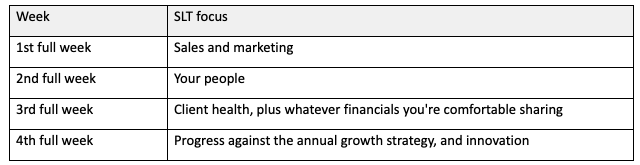
Follow this rhythm, encourage SLT members to do something similar with their own teams, and the seemingly random chaos slowly recedes.
4. Triage your clients
How well do you know how your accounts are going? You know your own. What about the others? Which clients are profitable? Which could use a check-in from you? Who do you need to see face-to-face in the next 90 days?
Moving from vibes to process starts with even a rudimentary way to assess client health, and an early warning system for account performance.
5. Document your critical processes
Hiring is hard enough. You can lose decent people by dropping them into chaos, where everything is muscle memory for the existing team and little is written down.
Look at functions that trip a lot of consultancies up: onboarding new clients, onboarding new people, preparing monthly invoices, pricing new opportunities, the processes behind your most important deliverables (or anything you deem mission critical). Absolutely include critical AI workflows only one person understands.
And by document, I mean prepare Standard Operating Procedures (SOPs). For the process-averse, this doesn't have to be a dense three-ring binder's worth of stuff. The key thing is to answer (and note that not every SOP will need all of these):
What is the process or deliverable?
When is it done and for whom?
When doesn't the process or deliverable apply?
What steps are involved and in what order?
What tools are used?
What are the dependencies?
What are the inputs?
How should AI be used?
What does the output look like? How to check for quality?
Who needs to sign off on the output?
As for who should prepare these, let's start with who owns them. It's your functional leaders (i.e. SLT members). They can write them, engage their team, use AI tools. It doesn't matter so long as they get completed, stay accurate and up to date, and are followed.
6. Set role expectations for your SLT
What's in each leader's portfolio? Which functional area do they own? What does success look like over the next 180 days or year?
Don't make it fancy. If you could measure one thing to see whether they're performing in the role, what would it be? Write it down and share it with them.
7. Decide who you say no to
Work with your SLT to codify the attributes of prospects you should turn away. There's a lot more you can do with refining your ICP and finding your secret sauce. But even this basic step keeps out the non-fit accounts that create chaos downstream.
It's also a good one for gathering input from every corner of the business, and for engaging your new SLT.
8. Start delegating
With your SLT established, delegate to them and hold them accountable for performance.
Everything else on this list matters, but delegation is what unlocks growth. If you insist on doing all the work or being in every decision, growth is capped by your personal bandwidth. Eventually your leaders quit to grow their careers somewhere else.
Worse, the ones who stay are the order-takers. You're stuck doing everything, and you remain a lifestyle business.
One teaspoon at a time
One of my favorite expressions is that you can't boil the ocean. If you're fighting fires on several fronts, resist the temptation to tackle every structural issue at once. It adds to the chaos and fatigues your team.
But there's a coda to that saying. It turns out you can boil the ocean, just one teaspoon at a time:-)
Think about where you stand on each of the eight areas above, and put your six to 12-month plan together.
Want to hear more about our perspective on operations, AI, and scaling a professional services business past $10MM in revenue? Subscribe to our newsletter or hit us up to chat!