Waive the Invoice Before They Ask
The most underrated retention tool in an agency isn't a QBR, a discount, or a steak dinner. It's giving a month back. And the entire value of it depends on doing it before the client asks.

Every agency client hates team churn. You swap an account lead, a strategist, an analyst. And even if the new person is better, the client feels the cost. They have to re-explain their business, re-build trust, re-teach the nuances you'd finally internalized. It's disruptive, it's a little disrespectful of their time, and it's also completely unavoidable. People leave. Teams shift. Folks get promoted. That's agency life.
But "unavoidable" and "no big deal" are not the same thing. When you've shuffled a client's team for the third time in a year, that client is, frankly, getting screwed — and they know it. The relationship may quietly be at risk, whether or not anyone's said so out loud.
Here's the move I used for years and learned as a leader at my old agency, and the one I still coach agency leaders to keep in their back pocket: proactively waive 50% to 100% of a month's fee to acknowledge severe disruption. Mechanically, the cleanest way to do it is to push the contract end date out by a month. The client gets a free month of work, and you've quietly extended both the relationship and the renewal window at the same time.
I'm not suggesting you do this every time you think a client may not be happy. I'm suggesting that, used well, it's the cheapest and highest-leverage instrument you have for two things at once: showing a client real empathy when they deserve it, and protecting an asset worth far more than the fee you're waiving.
Where this came from
I didn't invent this. I learned it from the founder of the agency where I spent over a decade as COO, one that grew from $5M to north of $30M. He was waiving fees long before anyone ran a spreadsheet on it. He did it because he believed it was the right way to treat a client who'd been put through the wringer, and he was right.
What I've done since is bolt the math onto his instinct. Partly to defend the practice to a skeptical CFO. But mostly because "it's the right thing to do" is tricky to scale across thirty account leads, but a rubric travels, and also because I love math.
You already make this call. You just do it by feel
I’m willing to bet any agency owner reading this already makes this decision. You feel a relationship cooling. You sense a client is one bad month away from quietly taking a meeting with a competitor. And somewhere in your gut, a little voice says we should do something for them. You're usually right. Owners have remarkably good instincts about which relationships are at risk.
The problem isn't the instinct. It's that your instinct doesn't scale. You can't hand your gut to a junior account lead and tell them to use it. You can't put vibes in an operating playbook. The moment you want this to happen consistently across every team, every account, without you in the room, you have to convert the feel into a number.
All the math below is your instinct, made teachable.
The three triggers
In my opinion there are three triggers for why should consider waiving fees. Be honest about which one you’re in.
1. We failed. Quality, errors, dropped balls, poor client comms. Basically, we didn’t deliver what the client paid for.
2. We put them through the wringer. Team shifts, the third SEO strategist swap in a year. We caused disruption for the client, even when each account departure was reasonable on its own.
3. Conviction. We believe in a fix or tactic so strongly (think analytics tracking update, content investment, etc.) that we’ll fund it ourselves to break the client’s hesitation.
The first two are restitution: you owe the gesture, and the math only tells you how big, not whether. The third is an investment and that’s where the matrix earns its keep.
The whole game is timing
Before the math, the single most important thing about this play: it only works when you're proactive.
The exact same dollars sent at two different moments send opposite signals.
Wait until the client is fuming, or until they've discovered the performance gap themselves, and the gesture reads as exactly what it is: a cynical, "typical agency trying to save its own hide" move. You've confirmed their worst suspicion. You're not generous; you're cornered.
Offer it first — before they complain, before the renewal conversation, the moment you know you've put them through it — and it reads as integrity. You saw the problem before they had to point it out. You named it. You put your own money on it. That's not a refund; that's a relationship.
You cannot outsource the timing to a client's complaint. The window is short, and it closes the instant they bring it up first. Which is also why this decision has to live with the team lead, the leader closest to the relationship, and not climb an approval chain. By the time a fee waiver clears three layers of the food chain, the only moment that mattered could be gone.
And there’s even more nuance than that!
Scenario 1: Billy the Paid Media Strategist gives you 2 weeks notice (ouch!). This would be the third Strategist swap in the last nine months.
Approach A - You take a day to get your wits about you and plan, then you call the client to notify the client and waive a month
Approach B - You dilly dally, hem and haw, then call the client a couple days before Billy’s last day and then offer to waive a month.
The client is going to be pissed on Billy’s news either way, but which one approach would most soften the blow?
Now consider this scenario.
Scenario 2: In a recent 1:1 with SEO Strategist Suzie you learn that the client hasn’t been implementing any recommendations for the past few months and so performance is well behind goals. The day-to-day client POC knows, but you know her VP doesn’t because if she did you would have already gotten a nasty email.
Approach A - You call the VP, give her the situation, and then offer to waive a month. You suggest they use the dollars to buy more freelancer time to write articles from Suzie’s accumulating briefs.
Approach B - You dilly dally, hem and haw, and then in a few weeks you get a scathing email from the VP asking why organic leads are down. You call her to explain and then offer to waive a month.
I can tell you from experience that Approach A is a vastly better and less fatal play than Approach B.
Now the math, because someone's going to ask
Take a $120K/year client — $10K a month, a realistic mid-market account. At a 20% net margin, that's $24K a year in profit. If they stay three years, you're protecting $72K in lifetime profit. A full month's fee is $10K.
Run the two scenarios after a rough stretch of team churn:
Do nothing. Say you've got a coin-flip, 50% chance of keeping them. Expected profit: 0.50 × $72K = $36K.
Waive a full month ($10K), proactively. Say the gesture moves your odds of keeping them to 75%. Expected profit: 0.75 × $72K − $10K = $44K.
Look carefully: $44K > $36K. The waiver is worth ~$8K in expected value. You spent $10K to protect a $72K relationship and came out ahead.
The version that survives a skeptic
The weak point in that math is obvious: where did 50% and 75% come from? I made them up. So did you. So here's the better way to frame it and the one a CFO can't wave off.
You don't need to know the exact churn odds. You only need the gesture to clear a hurdle. That hurdle is just the waiver divided by the lifetime profit you're protecting:
$10K ÷ $72K = ~14%
In plain English: waiving a full month pays for itself the moment it improves your odds of keeping that client by more than ~14 percentage points. Waive half a month instead, and the bar drops to ~7%. Given how much agency retention rides on whether the client likes and trusts the team, that's not a heroic assumption.
Pick your own assumptions
Here's where it gets useful. Generalize that hurdle and the client's size drops out of the equation entirely. What's left are three numbers you can actually estimate: how much you waive, your net margin, and how long a good client tends to stay.
Below is the retention lift a full-month waiver needs to clear to be worth it. (Waiving half a month? Halve every number.)
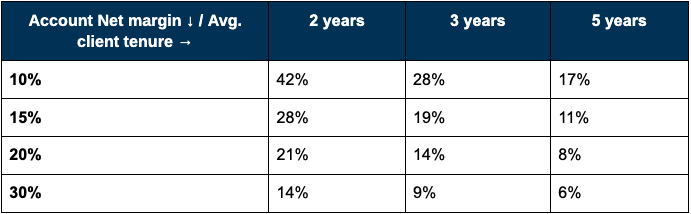
Read it like this: find your margin, find your typical client lifespan, and the cell is the question you're really answering, "Do I believe this gesture improves my odds of keeping this client by more than that?" If yes, do it. If no, don't do it. At least, not as an investment and as you’ll see in a minute, that’s not the only reason to waive a month.
The Account Net Margin illustrated is what you earn on the account you’re thinking about waiving fees for. Your overall agency margin is a good proxy if you don’t have that, assuming it's typical across your accounts.
Two things move the bar in your favor, and both are a little counterintuitive: higher margins and longer tenure both lower it. The healthier and stickier your shop, the more reason you have to make the gesture, because every retained year throws off more profit, while the waiver only ever costs you one month of revenue. The agencies most afraid to give a month back are often the ones with the most to gain from it.
And the kicker
In my experience, about half the time, the client says, "No, that's okay." They just wanted to be seen. They appreciated the gesture and waved it off.
Sit with what that does to the math. The goodwill comes from the offer. You only actually pay when they accept. So your real expected cost is closer to half the headline number — while you capture nearly all of the relationship benefit either way. The asymmetry is absurdly in your favor.
One more gut check: what does it cost you to replace a $120K client? The pitch, the BD time, the onboarding ramp, new clients are less profitable than mature ones. It's a multiple of $10K, easily. Retaining a great client for the price of a month is a massive bargain.
Trigger 3: Conviction
There's another, less obvious version of all of this. Sometimes you believe in a course of action that the client keeps balking at: fixing their broken analytics tracking, investing in a content hub, funding a creative asset you know will move the needle. They won't pull the trigger.
When you believe in it that strongly, divert a month of your billing to fund it. Move the dollars into the department or to a partner you trust that can execute the thing you're convinced will work.
That's not empathy; that's skin in the game. It tells the client you're not just trying to bill hours — you're so confident in the outcome that you'll put your own margin behind it. It breaks the stalemate, and it's the loudest possible signal that you're aligned to their results, not your invoice.
Being right isn’t being safe
And watch the trap hiding inside Trigger 1. “The client didn’t implement our recommendations” feels like their failure, not yours. It isn’t. If performance is flat because they sat on your advice, the real miss is that you didn’t go to the mat, escalate past your day-to-day contact, halt the work, divert fees to a freelancer and just get it done. Because the reckoning always comes. A Finance Director eventually runs the numbers, or a new CMO walks in, and asks why they’re paying $X a month for nothing. “We told them” won’t save you; you’ll get fired with a clean conscience and open slots in your resource forecast. Being right is not the same as being safe.
Guardrails, so this doesn't become a freebie machine
The obvious objection: won't clients learn to expect this? Won't it train them to manufacture outrage for a discount?
No, if you keep the firewall intact. The firewall is that you offer; they don't ask. The moment a client is demanding a waiver, you're back in the cynical, reactive quadrant and the magic is gone. So:
Tie it to real, identifiable triggers like the third team change in a year, a missed performance threshold, a genuine quality slip. Set the marker in stone.
Keep it at the team lead's discretion, with a simple heuristic, not a committee.
Don't make it routine. Its power comes from being rare, sincere, and unprompted.
But let’s not forget: we put the client through the wringer!
All this math gives the instinct a financial backbone, and that’s precisely its job: to reassure your finance team, not to settle your conscience. Because if you look closely, the three reasons to waive a month aren’t the same animal. Sometimes the disruption is just agency life and nobody failed — that’s an investment, and the matrix above is the right judge of it. But sometimes you genuinely let the client down, and that isn’t an investment at all. It’s restitution. You’re making things right. And restitution is the right move before you ever open the spreadsheet.
Here’s how I think about it. Giving line managers the latitude to do right by a client is how you scale this past your own involvement. But you can’t hand someone your gut, and your controller will want to know that any waiver follows a rubric with guardrails to “protect the house.” That tension is exactly what the model resolves.
So here’s the reconciliation. Earlier I said that if the gesture doesn’t clear the bar, don’t do it, and that’s true when the waiver is an investment. It is not true when you’ve failed the client. Then it doesn’t matter whether they’re new or old, small or large, low LTV or high: it’s the right thing to do. The matrix doesn’t get a vote on whether to make good. Its only jobs are to size the gesture and to give your finance folks the comfort to let it happen across your squad.
The bottom line
Waiving a month's fee isn't charity and it isn't weakness. Done reactively, it's a bribe that confirms the client's worst fear about agencies. Done proactively — the instant you know you've disrupted a relationship that matters — it's the cheapest, highest-trust retention instrument you own.
My old founder knew that on instinct. The math just proves he was right: the gesture pays off if it moves the needle by a single-digit-to-low-double-digit number of points, half your clients will thank you and decline anyway, and the relationship you protect is worth many multiples of the month you let go.
Don't wait for them to get upset. By then you've already lost the only thing that made it work.